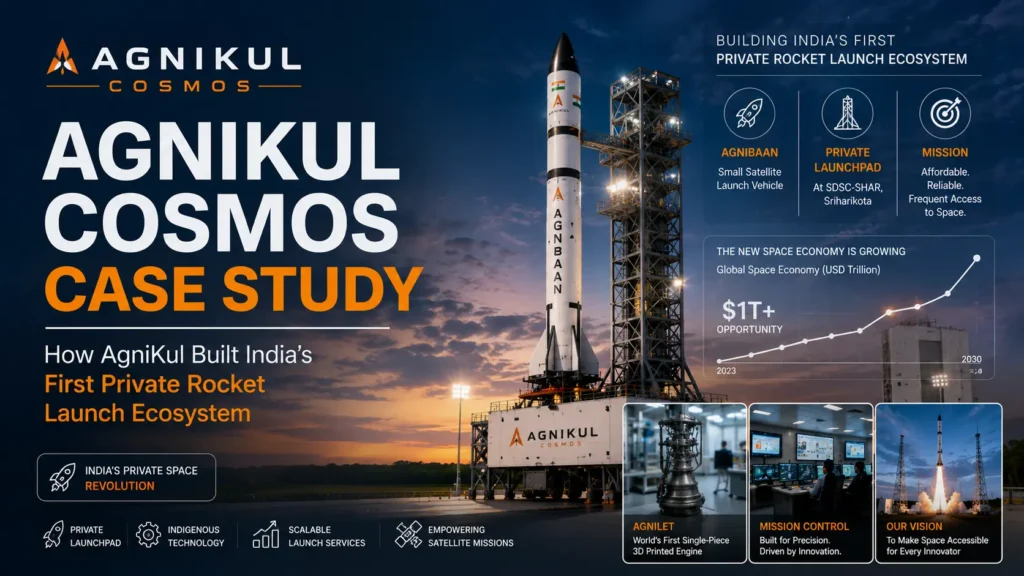
AgniKul Cosmos Case Study: How AgniKul Built India’s First Private Rocket Launch Ecosystem
- AgniKul Cosmos Case Study: How AgniKul Built India’s First Private Rocket Launch Ecosystem
- Why the Small Satellite Revolution Created a Huge Opportunity
- The Birth of Agnibaan
- The World’s First Single-Piece 3D Printed Rocket Engine
- Building India’s First Private Rocket Launchpad
- India’s Space Reforms Changed Everything
- Why Investors Backed AgniKul Cosmos
- Product-Market Fit Behind AgniKul’s Growth
- The Growth Strategy Behind AgniKul Cosmos
- Challenges Faced by AgniKul Cosmos
- Marketing Lessons From AgniKul Cosmos
- What Entrepreneurs Can Learn From AgniKul
- The Future of AgniKul Cosmos
- Conclusion
Introduction
Imagine building a rocket launchpad before launching your first commercial rocket.
Sounds risky.
Most startups focus on building a product first.
AgniKul Cosmos decided to build an entire ecosystem.
And that decision helped the company become one of India’s most exciting space-tech startups.
Today, AgniKul Cosmos is recognized as one of the pioneers of India’s private space revolution.
The company made headlines by developing Agnibaan, a launch vehicle designed for small satellites, and by building India’s first private launchpad at the Satish Dhawan Space Centre.
But AgniKul’s journey is much bigger than rockets.
It is a story about innovation, deep technology, persistence, and believing in a future that did not yet exist.
For decades, access to space was controlled by governments and large organizations.
Launching satellites was expensive.
Launch opportunities were limited.
Small companies often struggled to get their payloads into orbit.
This challenge was faced globally.
Satellite operators faced several problems:
- Long waiting periods
- High launch costs
- Limited launch flexibility
- Dependence on large launch providers
- Delays caused by shared missions
- Difficulty accessing dedicated launches
Meanwhile, demand for satellites was exploding.
Companies needed satellites for:
- Internet connectivity
- Agriculture
- Navigation
- Climate monitoring
- Earth observation
- Defense
- Research
The demand was growing.
But launch capacity was not growing fast enough.
This created a massive opportunity.
Most people saw challenges.
A group of engineers from Chennai saw a future industry.
That vision became AgniKul Cosmos.
This AgniKul Cosmos Case Study explains how the startup built India’s first private rocket launch ecosystem and became one of the most promising players in the country’s space-tech industry.
The Founders Behind AgniKul Cosmos
Every startup begins with a problem.
But great startups begin with a mission.
AgniKul Cosmos was founded in 2017 by Srinath Ravichandran and Moin SPM.
The founders believed that the future of space would belong to private innovators.
At the time, India was known for its successful space missions.
ISRO had already earned global respect.
However, private participation in the sector was still limited.
The founders saw an opportunity.
They believed smaller satellite operators needed more launch options.
They believed rockets should become more flexible and affordable.
Most importantly, they believed India could become a major player in the global commercial space industry.
That belief became AgniKul Cosmos.
The Problem AgniKul Wanted to Solve
The space industry was changing rapidly.
Satellites were becoming smaller.
Technology was becoming cheaper.
More organizations wanted access to space.
But launch services remained a major bottleneck.
Many customers faced challenges such as:
- Expensive launch services
- Long waiting periods
- Lack of dedicated launch vehicles
- Scheduling uncertainties
- Mission delays
Imagine building a satellite and then waiting months for a launch opportunity.
That was the reality for many companies.
The founders understood that the future would require faster and more flexible launch solutions.
Instead of treating satellites as cargo on larger missions, customers wanted dedicated launches.
This demand created a significant market opportunity.
Why the Small Satellite Revolution Created a Huge Opportunity
One of the biggest trends in the space industry is the rise of small satellites.
Traditional satellites often cost millions of dollars and required years to develop.
Modern satellites are different.
They are:
- Smaller
- Smarter
- Faster to develop
- More affordable
This shift changed the economics of space.
Universities started launching satellites.
Startups entered the industry.
Research institutions expanded their missions.
Governments invested in new space applications.
Industry reports estimate that thousands of small satellites will be launched during the coming decade.
Every one of those satellites needs a launch vehicle.
AgniKul recognized this trend early.
Instead of competing in traditional markets, the company focused on the future.
The Birth of Agnibaan
Every successful startup needs a product that solves a real problem.
For AgniKul, that product was Agnibaan.
Agnibaan is a customizable launch vehicle designed for small satellite missions.
The company built it with one goal.
Provide flexible and dedicated launch solutions.
Unlike traditional launch systems, Agnibaan allows customers to choose configurations based on mission requirements.
This flexibility became one of the company’s biggest advantages.
Customers were no longer forced to fit into predefined launch schedules.
Instead, launch services could adapt to customer needs.
That customer-first approach helped AgniKul stand out.
The World’s First Single-Piece 3D Printed Rocket Engine
Innovation became one of AgniKul’s strongest competitive advantages.
The company gained international attention for developing Agnilet.
Agnilet is a single-piece 3D printed rocket engine.
This achievement was significant because traditional rocket engines often require multiple parts and complex assembly processes.
By using advanced manufacturing techniques, AgniKul reduced complexity.
The benefits included:
- Lower costs
- Improved efficiency
- Improved efficiency
- Reduced manufacturing time
This innovation demonstrated the company’s engineering capabilities.
It also attracted investor interest.
In deep-tech industries, strong technology often becomes the biggest growth driver.
Building India’s First Private Rocket Launchpad
Most startups build products.
AgniKul built infrastructure.
One of the company’s most historic achievements was the development of India’s first private launchpad and mission control center.
The facility was established within the Satish Dhawan Space Centre in Sriharikota.
This was a major milestone for India’s private space industry.
Why was it important?
Because launch infrastructure is one of the biggest barriers in the aerospace sector.
By building its own launch ecosystem, AgniKul gained greater operational control.
The company could test, prepare, and execute missions more efficiently.
This achievement also demonstrated growing collaboration between public institutions and private innovators.
India’s Space Reforms Changed Everything
Timing is often as important as technology.
For years, private participation in India’s space industry remained limited.
Things started changing when the government introduced reforms.
New policies encouraged private innovation.
Organizations such as IN-SPACe were established to support private participation.
This created opportunities for startups like AgniKul.
The company entered the market at exactly the right time.
The combination of regulatory support and growing market demand created a powerful environment for growth.
Many successful startups benefit from market timing.
AgniKul is a perfect example.
Why Investors Backed AgniKul Cosmos
Space startups require significant capital.
Investors only support these businesses when they see strong potential.
AgniKul attracted funding because it offered several advantages.
Strong Founding Team
The founders had technical expertise and a clear vision.
Massive Market Opportunity
The satellite launch market is expected to grow significantly over the coming years.
Proprietary Technology
The company’s innovations created strong competitive advantages.
Infrastructure Ownership
Building a private launch ecosystem strengthened the company’s position.
Long-Term Potential
Investors recognized the possibility of creating a globally competitive space company.
These factors helped AgniKul secure funding from leading investors and strategic partners.
Product-Market Fit Behind AgniKul’s Growth
Every startup eventually reaches a stage where customers actively seek its solution.
This is called product-market fit.
AgniKul achieved this by focusing on customer pain points.
Satellite operators wanted:
- Dedicated launches
- Faster mission timelines
- Lower costs
- Greater flexibility
The company built its services around these needs.
Rather than forcing customers to adapt, AgniKul adapted to customers.
That approach accelerated adoption.
The Growth Strategy Behind AgniKul Cosmos
Several factors contributed to the company’s growth.
1. Focused Market Positioning
The company targeted small satellite operators.
This helped build expertise and market credibility.
2. Technology-Led Innovation
AgniKul invested heavily in research and development.
Innovation became a core strength.
3. Infrastructure Development
Building launch infrastructure created long-term advantages.
4. Strategic Partnerships
Collaboration helped accelerate growth and improve capabilities.
5. Long-Term Vision
The company focused on creating lasting value rather than chasing short-term results.
These decisions helped establish a strong foundation for future expansion.
Challenges Faced by AgniKul Cosmos
The journey was not easy.
The company faced several challenges.
High Development Costs
Rocket development requires significant investment.
Technical Complexity
Building reliable launch systems is extremely difficult.
Regulatory Processes
The company had to operate within a highly regulated industry.
Building Market Trust
Customers needed confidence in the company’s capabilities.
AgniKul addressed these challenges through testing, innovation, and consistent execution.
Marketing Lessons From AgniKul Cosmos
The AgniKul Cosmos Case Study offers powerful lessons for entrepreneurs and startup founders.
Solve Difficult Problems
The biggest opportunities often exist in difficult industries.
Innovation Creates Competitive Advantages
Unique technology can become a powerful differentiator.
Timing Matters
Entering the market during industry transformation creates opportunities.
Build for the Future
The company focused on long-term industry trends rather than short-term demand.
Trust Is Essential
In aerospace, trust is one of the most valuable assets.
AgniKul earned trust through execution and innovation.
What Entrepreneurs Can Learn From AgniKul
The startup’s journey offers valuable insights.
- Think long-term.
- Focus on meaningful problems.
- Invest in innovation.
- Build strong foundations.
- Adapt to changing markets.
- Stay committed to your vision.
Many founders avoid difficult industries.
AgniKul embraced one of the hardest industries in the world.
That decision helped create a company with enormous future potential.
The Future of AgniKul Cosmos
The future of commercial space activity looks promising.
Demand for satellites continues to increase.
Private participation is growing globally.
New opportunities are emerging in:
- Satellite deployment
- Commercial launches
- Space infrastructure
- Earth observation
- Communication services
AgniKul is well positioned to benefit from these trends.
Its technology, infrastructure, and market positioning provide a strong platform for future growth.
The company remains one of India’s most promising space-tech startups.
Conclusion
The AgniKul Cosmos Case Study is a powerful example of how vision, innovation, and persistence can transform an industry.
The founders saw an opportunity where others saw challenges.
They built advanced technology.
They created India’s first private rocket launch ecosystem.
They positioned themselves at the center of a rapidly growing market.
The biggest lesson is simple.
Sometimes success comes not from building a better product but from building an entirely new ecosystem.
AgniKul Cosmos proved that with the right vision, even one of the world’s most complex industries can be reimagined.